Ragdoll Basketball 3D
- 3.6
- Rating
- 50.00K
- Installs
- Free
- Price

 Analysis by App-foxy
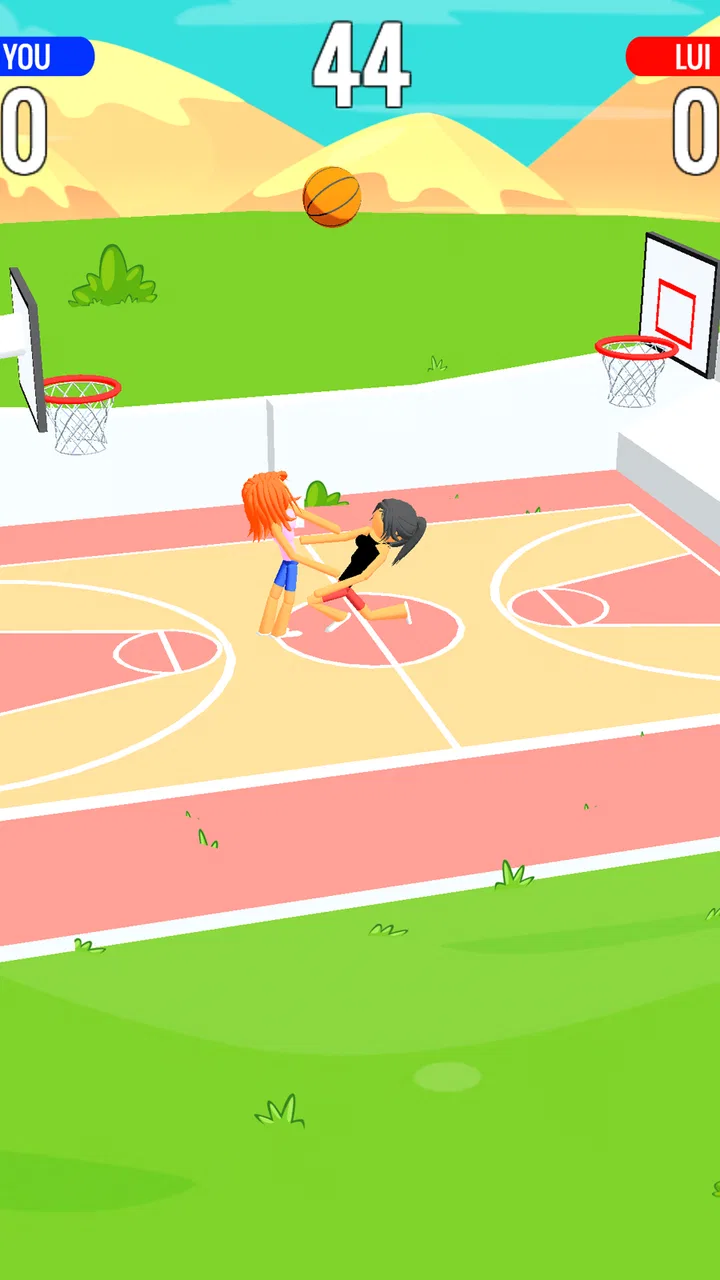
Ragdoll Basketball 3D is the kind of sports game I open when I want a quick laugh rather than a serious basketball simulation. Its central idea is simple: control a loose, floppy player and try to turn awkward movement into a successful shot. That focus gives the game its personality. Instead of asking me to memorize plays or manage a full team, it makes the physical act of getting airborne and putting the ball through the hoop the whole challenge.
After spending time with it, I found that the most important skill is not traditional basketball knowledge. It is learning how the ragdoll movement reacts to my input. A clean-looking dunk can become a clumsy fall, while a badly timed jump sometimes turns into an unexpectedly satisfying basket. That unpredictability is both the attraction and the main limitation. This is a physics-driven basketball toy first and a conventional sports game second.
The game is free, belongs to the sports category, and comes from Deli ventures. It is aimed at Teen players, runs on Android 8.0 or later, and its current version is 1.1.5. The store summary points toward powerful dunks and long three-point attempts, but the real appeal for me is the short experimental loop: move, jump, aim, recover from a mistake, and try again.
You May Also Like

 Blood Strike: 2.5 Anniversary
Blood Strike’s Loadouts Turn Every Drop Into a Tactical Gamble
A close look at Blood Strike’s custom loadouts: how fast access to signature weapons reshapes its battle royale rhythm, rewards preparation, and narrows the gap between fights.

 Pandora - Music & Podcasts
Pandora’s Music Is Easy to Start, but Harder to Recover
Pandora’s strength is its low-effort path from a seed to a station. Its weak spot is how much confidence it asks you to place in connection, setup, and quiet recovery.

 8 Ball Pool
 Is Built on Rivalries, Rematches, and Routine
A close look at the rivalries, rematches, shared routines, and unanswered safety questions that turn a quick pool match into a persistent mobile community.

 Samsung Music
’s Quiet Strength Is Playing What You Already Own
Its reach comes less from spectacle than from dependable access to a personal library. That simplicity is both the app’s strongest retention engine and its ceiling.

 AccuWeather: Weather Radar
AccuWeather Review: A Quick, Clear Forecast for Everyday Decisions
For everyday plans, the best forecast is the one you can understand quickly. AccuWeather makes rain timing, radar, and local conditions easy to act on, with a few trade-offs.

 Hill Climb Racing
Why Hill Climb Racing Still Turns Crashes Into One More Run
A tiny car, a bumpy hill and one more upgrade: Hill Climb Racing keeps resurfacing because its simple chaos makes every near-miss feel personal.
More From Our News Desk



Why the ragdoll shooting idea matters
In a standard basketball game, success usually comes from timing a button, choosing a play, or controlling a polished athlete with predictable animation. Here, the loose body changes the feeling of every attempt. I am not simply selecting “dunk” or “shoot.” I am trying to position a body that can wobble, tip, and lose balance before the ball reaches the basket.
That difference makes even a familiar action feel fresh. A long shot is not interesting only because it is worth more in a normal basketball sense; it is interesting because I have to judge whether the character can stay controlled long enough to release it. A dunk is not just a powerful finish. It is a small stunt in which the approach, jump, body angle, and landing all affect how convincing the result feels.
The best moments come when I stop fighting the awkwardness and start using it. Early on, I tried to force every action into a straight, professional-looking motion. That approach made the game feel unreliable. Once I accepted that the character would move in a loose and exaggerated way, I began treating each attempt as a timing puzzle. The goal became creating a favorable sequence rather than demanding perfect control.
This is also why the game can be entertaining in short sessions. I do not need to build a long strategy before playing. I can make a few attempts while waiting for an appointment, take a break after a frustrating run, and return later without needing to remember a complicated system. The low commitment suits the playful concept.
Learning the movement instead of chasing realism
The first useful adjustment is to separate movement from ambition. When I immediately aim for a spectacular dunk, a small mistake can send the player into an unhelpful position. I get better results by first learning how much control I have over approach and jump timing. A modest successful shot teaches more than a dramatic attempt that fails before I understand why.
I also found it helpful to watch the character’s body rather than stare only at the hoop. The body position tells me whether the next input is likely to stabilize the attempt or make it worse. When the player is already leaning, adding another aggressive movement may produce a funny failure instead of a controlled finish. This is a small but important change in attention, and it makes the physics feel less random.
Another practical habit is to treat misses as information. If the ball goes wide after the character twists, the problem may not be the target itself; it may be the body orientation at release. If a jump looks promising but ends with a poor landing, the approach may have been too ambitious. The game rewards this kind of observation more than repeatedly tapping without changing anything.
How the main actions feel in practice
Dunks are the most immediately entertaining part because they showcase the ragdoll concept clearly. A successful one has a satisfying sense of momentum, while a failed one can be amusing precisely because the player does not move like a perfectly animated athlete. I never felt that every dunk attempt was equally dependable, though. The setup matters, and forcing the action from a poor position usually creates a messy result.
Long three-point attempts offer a different kind of challenge. They are less about the spectacle of contact with the rim and more about judging release and direction. When I wanted a calmer practice routine, I used these shots to focus on consistency. Their value is not only in scoring from distance; they help reveal how sensitive the game is to positioning and timing.
The ragdoll handling also creates a trade-off between control and entertainment. A highly predictable system would make it easier to repeat the same successful move, but it would remove much of the personality. Conversely, too much looseness would make the outcome feel disconnected from my decisions. In my experience, the game is most enjoyable when I am close enough to success to believe that a better-timed attempt will work, even if the result still has a playful wobble.
A realistic everyday session
Imagine having ten minutes before leaving home. I would not choose this game to complete a serious career mode or study detailed team statistics. I would open it for a handful of attempts, begin with simple shots, and then try one or two longer efforts once my timing felt comfortable. If a dunk failed in a ridiculous way, that failure would be part of the entertainment rather than a reason to restart a long campaign.
That same pattern works during a short commute break or after finishing a demanding task. The game has a clear immediate purpose, so I can start playing without preparation. It is especially suitable when I want something interactive but do not want the concentration required by a competitive multiplayer match or a full simulation.
There is a useful social angle too, even without turning the experience into a formal competition. Handing the phone to a friend and asking for one impressive dunk or one distant basket creates a quick challenge. The ragdoll behavior makes outcomes easy to react to, because a spectacular success and an awkward collapse are both memorable. I would not use it as a replacement for a deep head-to-head sports game, but it works well as a casual pass-and-play amusement.
Where it differs from ordinary basketball alternatives
Compared with a realistic basketball simulator, Ragdoll Basketball 3D removes much of the management and presentation that serious players may expect. I do not approach it for authentic team tactics, detailed athlete control, or a long competitive structure. Its strength is the physical joke built into every movement, not a faithful recreation of a professional game.
Compared with a standard arcade basketball title, it is also less about clean, repeatable scoring patterns. Many arcade games make the player feel powerful quickly. This one makes the player negotiate an unstable body, so the satisfaction comes from taming the awkwardness. If I want immediate precision and a polished, predictable response, another arcade option may suit me better.
On the other hand, many conventional alternatives cannot reproduce the same comic tension. In a normal game, missing a shot is simply a miss. Here, the way the player arrives at the miss can be as entertaining as the basket itself. That makes this a better choice for people who enjoy physics-based surprises and do not need every failure to feel fully deserved in a competitive sense.
The trade-offs I noticed
The biggest friction is the same feature that gives the game its identity: ragdoll control can feel imprecise. Players who prefer direct, exact commands may interpret the loose movement as inconsistency. I sometimes knew what I wanted to do but could not make the body express it cleanly. That did not ruin short sessions, but it would become tiring if I expected the game to provide strict technical mastery.
There is also a ceiling to the concept. Once the novelty of watching awkward dunks and distant shots has settled, the experience depends on whether the available attempts continue to feel varied enough for the individual player. Someone looking for a broad basketball package may quickly notice that this is a focused game built around one unusual interaction rather than a complete sports universe.
The Teen content rating is worth keeping in mind for families choosing games for younger children. The rating does not make it unsuitable for every teenager, but parents should use their own judgment rather than assuming that a cartoon-like sports presentation automatically fits all ages.
Because the game is free, it is easy to try without committing money. That makes the limitations easier to accept, especially if I approach it as a quick physics experiment. Still, free access does not change the basic recommendation: do not install it expecting the depth of a premium basketball simulation. Its value comes from brief, amusing interaction, not from replacing every other sports game on a phone.
Small techniques that improve the experience
My first tip is to begin with controlled attempts instead of immediately repeating the most spectacular move. A simple shot gives me a reference for how the character responds. From there, I can change one part of the attempt at a time, such as the approach or the release. This makes the physics easier to read and prevents a string of identical mistakes.
My second tip is to use failed landings as a warning about setup. When the player reaches the basket in a poor body position, the problem often started before the jump. I found that preparing the approach more carefully was more useful than trying to correct everything in midair. That lesson is not obvious from the short store description, but it is central to making the game feel more responsive.
My third tip is to alternate goals. I would spend one short run trying to make a clean dunk, then switch to long attempts, then return to a safer shot. This keeps the game from becoming a single repeated trick and helps expose which part of the control model I actually enjoy. It also turns a disappointing dunk streak into a chance to practice another style of play.
A fourth useful approach is to judge the game by entertainment per minute rather than by a conventional win rate. If a failed attempt makes me laugh and teaches me something about the movement, it has still served its purpose. That mindset is especially important here because demanding flawless consistency can make the loose physics feel more frustrating than funny.
Who will get the most from it
I would recommend this game to casual sports fans, players who enjoy ragdoll physics, and anyone looking for a free distraction with a clear central gimmick. It is a good fit for someone who likes experimenting with timing and watching unexpected outcomes. The modest audience is reflected in its average rating of 3.6 from around 25 ratings, while its reach has passed 50 thousand installs. Those figures suggest that it has found a small but real audience rather than presenting itself as a universal basketball replacement.
It is also a reasonable choice for a player who wants to test whether a physics-based sports game feels enjoyable before spending money elsewhere. The low barrier makes that experiment simple. I would install it when I wanted short attempts, a playful tone, and a basketball theme without the responsibility of managing a full team.
I would skip it if my priority is accurate simulation, deep progression, online competition, or highly dependable controls. A player who enjoys perfecting repeatable combinations may become annoyed by the same looseness that I found funny. Likewise, someone seeking realistic basketball rules and presentation should choose a more traditional sports title.
The developer, Deli ventures, has kept the concept focused enough that the game is easy to understand almost immediately. That focus is a strength, but it also means the experience asks the player to enjoy the core idea on its own terms. There is no reason to approach it expecting a broad collection of basketball activities when its appeal is concentrated in the act of making a floppy player attempt an impressive shot.
My final recommendation
Ragdoll Basketball 3D works best when I treat it as a compact physics playground with a basketball wrapper. The fun comes from learning how to turn unstable movement into a dunk or a long-distance basket, then enjoying the strange failures that happen along the way. It is not the right choice for a serious sports simulation, but it can be a surprisingly effective break when I want something immediate and lightly chaotic.
Its free price and Android 8.0 compatibility make trying it straightforward for supported devices. The current version is 1.1.5, and the game was released on June 25, 2021, so I would judge it by the focused experience it offers rather than by expecting the scope of a newer, larger basketball production. For me, the recommendation is clear but specific: install it for short, physics-based fun, keep your expectations away from realism, and give the ragdoll movement time to become the joke rather than fighting it.
FAQs for Ragdoll Basketball 3D
01What is Ragdoll Basketball 3D all about?
Ragdoll Basketball 3D is a fun and unique sports game where players control ragdoll characters in a whimsical basketball environment. The game combines realistic physics with comedic animations, providing an entertaining twist to traditional basketball gameplay. Players can enjoy single-player modes or compete against friends, making it perfect for casual gaming sessions.
02Is Ragdoll Basketball 3D available for both Android and iOS?
Yes, Ragdoll Basketball 3D is available for download on both Android and iOS platforms. Users can find it on the Google Play Store and the Apple App Store. Ensure your device meets the minimum system requirements for optimal performance and gameplay experience.
03Are there any in-app purchases in Ragdoll Basketball 3D?
Ragdoll Basketball 3D offers in-app purchases that enhance the gaming experience. Players can buy additional skins, power-ups, and other cosmetic items. While these purchases can enrich gameplay, they are entirely optional and the game can still be enjoyed fully without spending any money.
04How does the multiplayer feature work in Ragdoll Basketball 3D?
The multiplayer feature in Ragdoll Basketball 3D allows players to compete against friends or other online users. It supports both local and online multiplayer modes. Players can challenge each other in real-time matches, making it a great option for those who enjoy competitive gaming.
05What are the main features of Ragdoll Basketball 3D?
Ragdoll Basketball 3D boasts several exciting features, including a variety of challenging levels, customizable ragdoll characters, and realistic physics-based gameplay. The game also offers both single-player and multiplayer modes, ensuring a diverse gaming experience that caters to different player preferences.
Pros
- Unique ragdoll physics enhance gameplay.
- Simple controls make it easy to learn.
- Engaging multiplayer mode available.
- Vibrant graphics add to the fun.
- Regular updates with new features.
Cons
- Occasional lag in online matches.
- Limited customization options.
- Ads can be intrusive at times.
- In-app purchases might be pricey.
- Requires stable internet for best play.

Ragdoll Basketball 3D
Gallery